
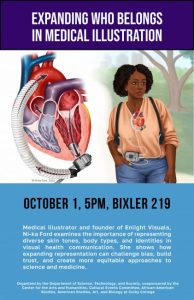
This talk explores how the images used in medicine shape understanding, empathy, and patient care. Through the lens of inclusive medical illustration, it examines the importance of representing diverse skin tones, body types, and identities in visual health communication, and how expanding representation among both visual creators and within medical imagery can help challenge bias, build trust, and create more equitable approaches to science and medicine.
Ni-ka Ford is a Board Certified Medical Illustrator and Founder of Enlight Visuals, a medical and scientific visualization studio specializing in accurate and inclusive visuals for healthcare materials and medical and scientific literature. Combining her artistic abilities with research in science and medicine, she creates compelling visuals for both expert and lay audiences. An Atlanta native, Ford graduated from Georgia Southern University with a Bachelor’s in Fine Arts. She then attended the University of Illinois at Chicago, graduating with a Master of Science in Biomedical Visualization in 2017. As a medical illustrator, Ford has worked with clinicians, physicians, and researchers to create science graphics, surgical illustrations, 3D models, visual aids for teaching medical students, illustrations for journal publications, and research grants.
Ford’s visit to Colby is cosponsored by the Center for the Arts and Humanities, the Cultural Events Committee, and the Departments of American Studies, African-American Studies, Art, and Biology.
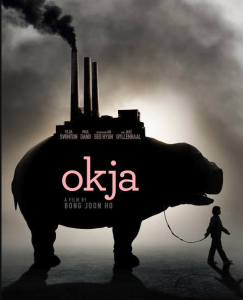
A young girl risks everything to prevent a powerful, multinational company from kidnapping her best friend – a fascinating beast named Okja.
Sponsored by the Center for the Arts and Humanities.
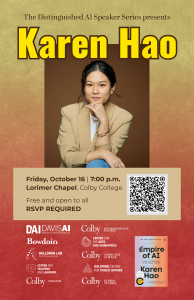
Join Karen Hao, award-winning journalist & NYT bestselling author, writing & speaking about the impact of artificial intelligence on society.
Please note that attendees must register via EventBrite.
Registration closes at 5:00 PM on Thursday, October 15.
All registrants must present a government-issued ID or student ID upon arrival at Lorimer Chapel.
Organized by the Davis Institute of Artificial Intelligence, with sponsorship by the Center for the Arts and Humanities, departments of Environmental Sciences, Computer Science, Global Studies, and English, the Halloran Lab for Entrepreneurship, the Goldfarb Center for Public Policy, the Center for Teaching and Learning, and Bowdoin College.
Se Young (Seth) Kim is an Assistant Professor of Global Cinema and Digital Media in the Cinema Studies Department. He is the author of The Intimate Violence of South Korean and Japanese Cinema. His research interests include South Korean, Japanese, and US cinema and media, including video games and streaming media, with a focus on the use of violence. He is also a martial artist and instructor of Filipino Combat Systems.
Serena Ferrando is Assistant Professor of Environmental Humanities and Italian at Arizona State University. Her book, Channelling Nature: Plants, Animals, and Water in Italian Poetry (Toronto University Press, 2026), is an eco-digital study of the nonhuman in contemporary poetry. Dr. Ferrando directs a digital humanities project on Milan’s water canals called Navigli Project.
She also studies environmental and experimental noisescapes and develops multimedia projects that utilize digital mapping to create a multisensory experience of the world. Her work has appeared in ISLE: Interdisciplinary Studies in Literature and Environment, Ecozon@, Italian Culture, Italica, Humanist Studies & the Digital Age, Rivista di studi italiani, and the volumes Italy and the Ecological Imagination. Ecocritical Theories and Practices and Landscapes, Natures, Ecologies. Italy and the Environmental Humanities.

In a post-apocalyptic wasteland, a woman rebels against a tyrannical ruler in search for her homeland with the aid of a group of female prisoners, a psychotic worshipper and a drifter named Max.
Sponsored by the Center for the Arts and Humanities.
Mihku Paul is a multidisciplinary Indigenous artist and writer who grew up on a wild Maine river. She specialize in cutting edge collaborations including Spinning Wampum, Pejepscot Portage Mapping Project, Waponahki Studies Redux, Skoniminol Kuliwot (Good Seed) and others.
Mihku grew up on the Penobscot river, trained by a traditional Wolastoqey grandfather and a mother who ensured that she had every opportunity to acquire divergent skills.
Cathy’s current research focuses on the behavioral and physiological ecology of vertebrate animals and amphibian conservation. She and her students are studying the complex interactions among amphibian skin secretions and their antimicrobial properties, epibiotic bacteria, and how these regulate and potentially inhibit growth of microbial pathogens such as chytrid fungus. They are also studying behavior in amphibians using analysis of vocalizations and passive acoustic monitoring. Cathy has been involved in research investigating resiliance to development in the Belgrade Lakes Watershed.
Eloy Romero Blanco is a Visiting Assistant Professor in Latin American Studies at Colby College, where he teaches courses in Latin American and Caribbean history. He is interested in exploring the links between revolutions, anticolonial movements, and imperial rivalries in the Caribbean. His research examines how Cuban opponents of Spanish colonial rule navigated U.S. expansionism to pursue competing visions of Cuba’s future, ranging from annexation and the preservation of slavery to independence and abolition. His scholarship draws on archival research in Cuba, Mexico, Spain, the United Kingdom, and the United States. He received his Ph.D. in Latin American History from the University of Pittsburgh in 2026.
Jessamine Batario is an art historian, curator, and museum educator specializing in modern and contemporary art. Within this broad field, she is primarily concerned with issues of critical historiography, interrogating how histories are written in the first place. Her projects question canonical authority and advocate for a transgression of the traditional boundaries between the roles of historians and the roles of artists.
Batario’s current research and curatorial project features modern and contemporary art by artists with cultural heritage ties to Cuba, Guam, the Philippines, and Puerto Rico. This project critiques U.S. imperialism by foregrounding the lived experiences of those who resist U.S. interventions and interrogate their inheritance of colonialist narratives.
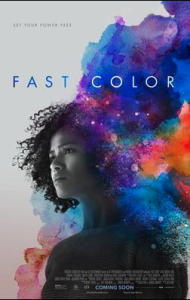
After years in hiding, a woman is forced to go on the run when her superhuman abilities are discovered. Years after having abandoned her family, the only place she has left to hide is home.
Sponsored by the Center for the Arts and Humanities.
Jorell Meléndez-Badillo is a historian of Puerto Rico, the Caribbean, and Latin America. His work focuses on the global circulation of radical ideas from the standpoint of working-class intellectual communities.
Dr. Meléndez-Badillo is the author of Puerto Rico: A National History (Princeton University Press, April 2024). The book is also available in Spanish as Puerto Rico: Historia de una nación (Translated by Aurora Lauzardo Ugarte, Grupo Planeta, 2024). It offers an accessible introduction to Puerto Rico, its history, and the contemporary political moment. It is a national history of a country without a nation state. It tells the story of how Puerto Rico has been colonized for more than five centuries. However, it also documents how the people have resisted colonial domination. Ultimately, the book will provide unfamiliar readers with an informed argument of how and why Puerto Rico arrived at its current juncture, as well as how Puerto Ricans are imagining possible futures in the face of austerity, failing infrastructures, and the rubble left behind by colonial neglect