
Picture this: you’re deep in the woods of Maine. Your Google Maps has long since stopped working, and you’re navigating an unmarked grid of forest roads. With you is a group of people, all passionate about the environment and there to learn more about what it means to be a steward and partner to the land.
This is a field trip to Milo, Maine. Everyone in the group is part of Introduction to Environmental Studies, taught by Chris Walker, Assistant Professor of English. Leading the discussion is Steve Tatko of the Appalachian Mountain Club (AMC) and a Colby alumnus of the class of 2010.
In conversation about the origins of the site visit to Milo, Walker explained that it “tied in with an ongoing conversation in the class about maintaining commons – spaces and resources that are for the public good.”. He continued, noting that “the AMC is one example of this, and students had the chance to work with Steve to think about the challenges and rewards of holding wooded land in commons, and working with Indigenous communities to do so.”
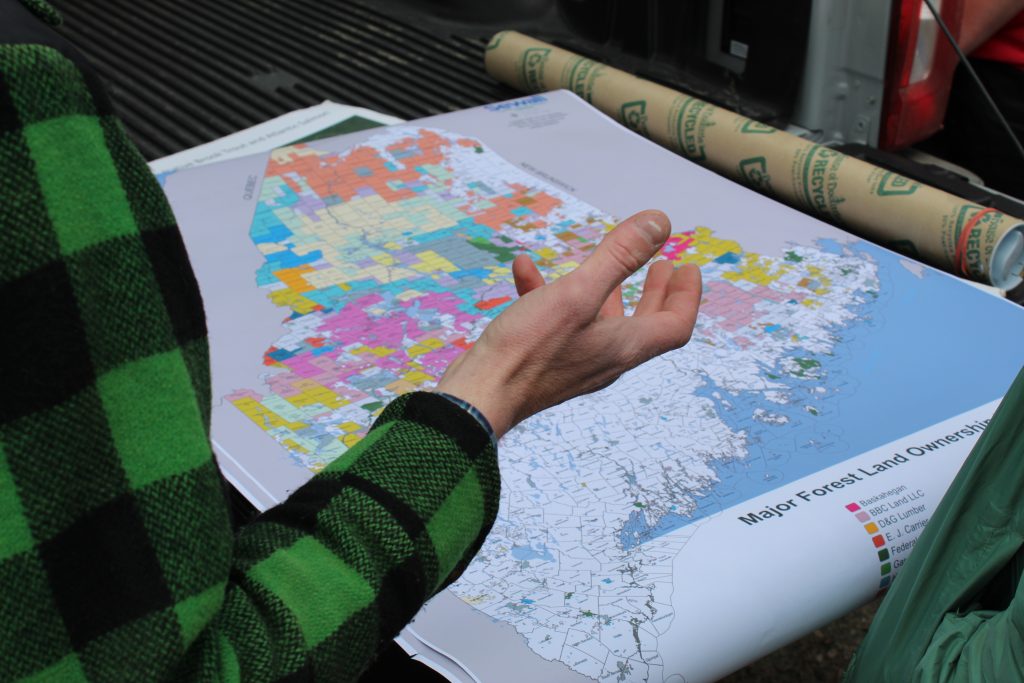
The day began with a 9 a.m. departure from Colby’s campus and a drive about an hour and fifteen minutes north to Milo, where the class met Tatko at a local grocery store. After a brief introduction to the AMC and its work with local communities, Tatko explained that many people in the area rely on logging for their livelihoods. As one of Maine’s private landowners, the AMC is committed to fostering more sustainable relationships between forestry, workers, and tribal communities. Spreading out maps of Maine, Tatko pointed to the organization’s holdings. That day, students would explore just a small part of them.
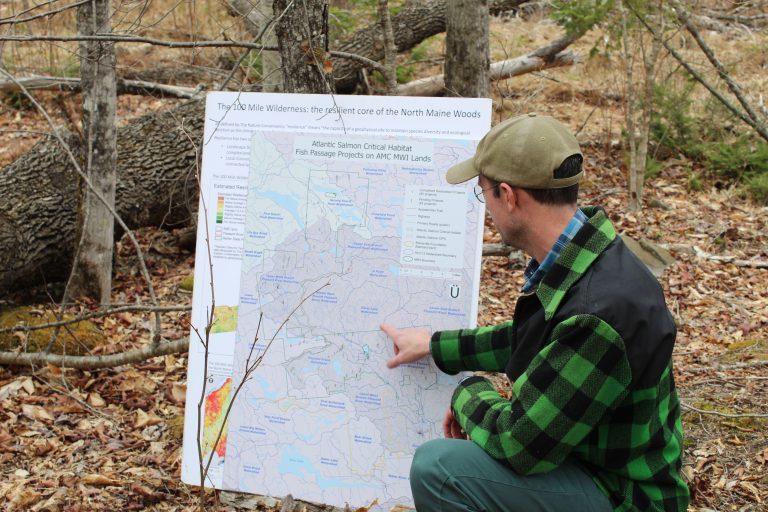
The first stop took the class off the grid to a parcel of forest managed by the AMC. Students unpacked their lunches and settled in for a conversation about what sustainable forestry looks like, seeing the practice in real time in front of them. Tatko spoke at length about the AMC’s partnership with the local Penobscot Nation. One of the major moments in this partnership includes the return of 1,700 acres of land, part of the tribe’s ongoing effort to restore portions of its ancestral territory.
Emersion Ritter ’29 was particularly struck by the discussion. “It was really valuable to see some Maine public lands and the AMC’s restoration efforts on our field trip. In our class, we’ve talked at length about humans’ place in the natural world, what responsibility we have to preserve it, and how those responsibilities often clash with industrial needs and local economies, so the work that the AMC is doing alongside loggers, local Mainers in Milo and elsewhere, and the Penobscot people was a direct tie-in that I really appreciated. I hadn’t realized just how much of Maine was privately owned by corporations and industries that pushed locals, especially Indigenous folks, off of their land, and that made hearing from the AMC all the more impactful.”
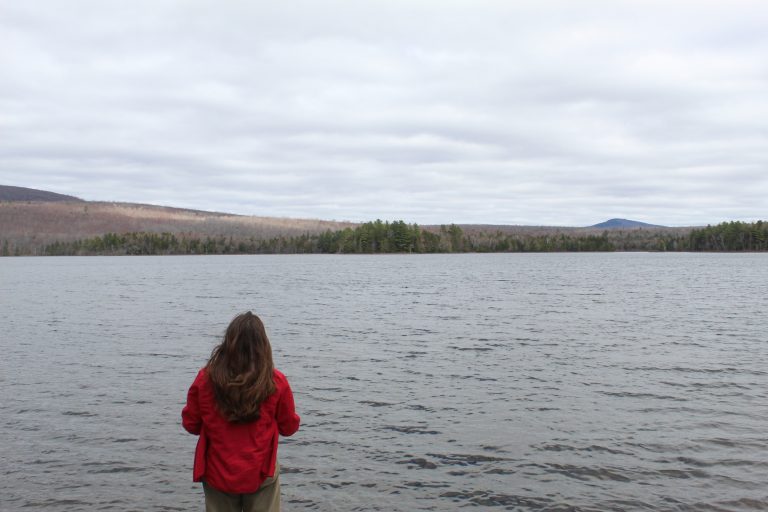
The next stop was a visit to Silver Lake, a location just about 20 miles north of Milo. Tatko explained that the lake, named by the Penobscot Nation for its once abundant alewives, has begun to see those fish return thanks to the removal of downstream dams and restoration efforts led by both the tribe and the AMC. Their return has also helped support the recovery of Atlantic salmon and Eastern brook trout.
Alex Jacobstein ’29 found these conservation efforts especially inspiring.”I’ve been interested in forest and freshwater ecology for a while now, but I didn’t know much about how these subjects could be applied. It was so awesome to see how knowledge in these areas could be used for meaningful conservation work like the restoration of Eastern brook trout populations or the improvement of forest health for more efficient carbon sequestration. As an aspiring biologist and environmental scientist, I could absolutely see myself getting involved in conservation projects similar to the ones Steve talked about.”
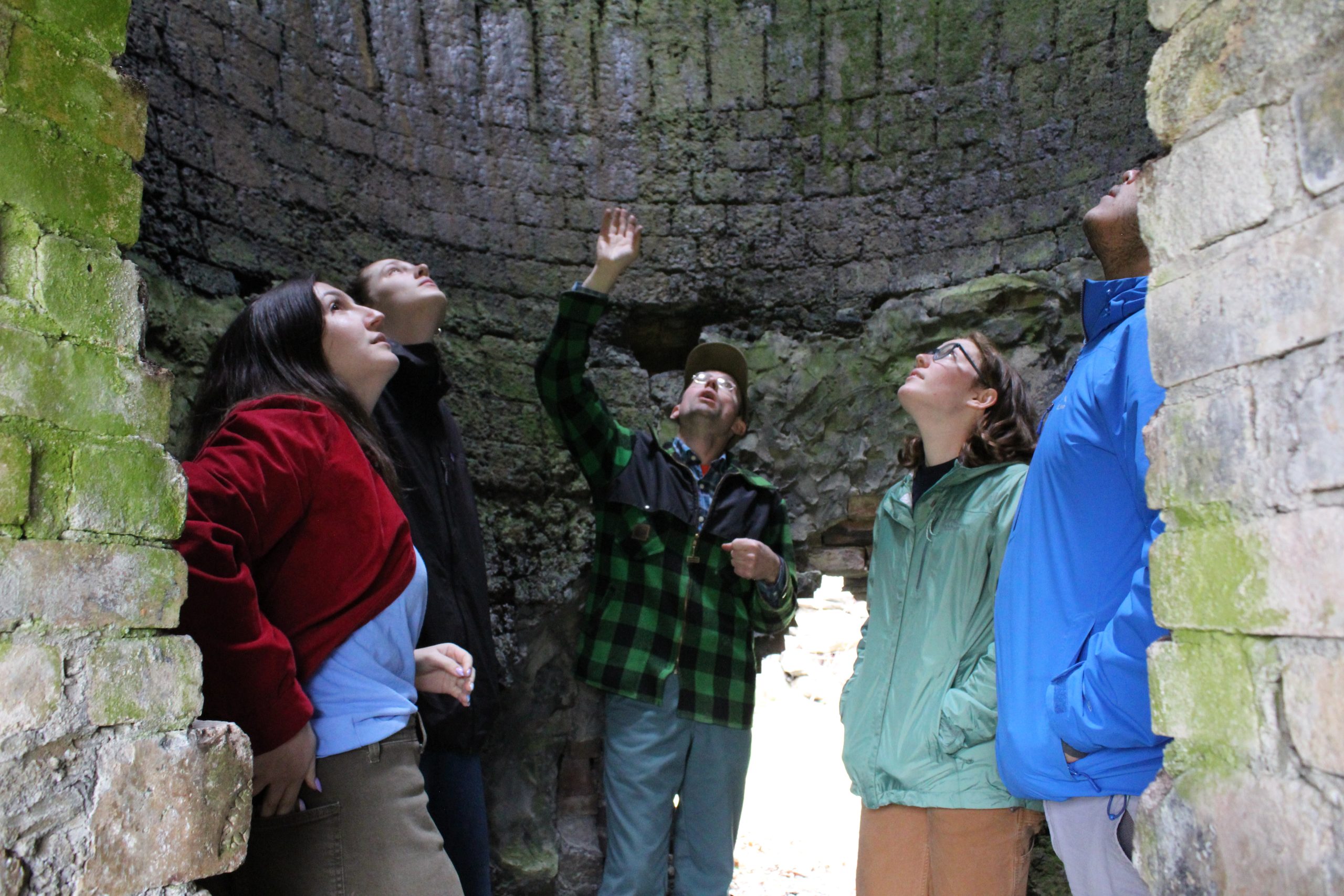
Adjacent to the lake sits the historic Katahdin Iron Works, where pig iron was produced from locally mined ore between 1845 and 1890. The site offered another lens to understand Maine’s environmental history. Tatko explained that the workers were often paid in company credit and became trapped in cycles of debt that prevented them from leaving. Throughout the day, he wove together the histories of logging, labor, conservation, and Indigenous stewardship, giving students a deeper understanding of the landscape around them.
By connecting classroom discussions with firsthand experiences, the trip turned ideas into something tangible. Students left not only with a greater understanding of Maine’s forests, but also with a deeper appreciation for the complex relationships between communities, history, and the land. The experience demonstrated that the environmental humanities extend beyond the classroom. The humanities can show up in remote and unexpected places, offering new ways to think about conservation, collaboration, and the role one may play in shaping more sustainable futures.
Story by Portia Hardy, CAH Program Coordinator. Photography by Chris Walker, CAH Faculty Associate Director and Assistant Professor of English.