
Each year, the Center for the Arts and Humanities organizes a unique theme which brings together faculty, staff, and students around one exciting topic. This past year’s annual theme, Food for Thought, nurtured a wealth of ideas around campus and in our Waterville community, growing new ways of thinking and being when it comes to our own relationships with food.
Food sustains all living beings (humans and non-humans) as it punctuates our daily lives and helps us survive and grow. It also embraces different realities of lived experiences across time and space, connecting the past with our present through the passing of ancestral traditions. Food highlights a living paradox: it represents the key ingredient that binds us together, and yet divides us when power dynamics and privilege are at play. By shedding light on these intricate realities, Food for Thought critically assessed the complex social, cultural, environmental, and political relationships that we have with food.
To reflect on this year’s Food for Thought activities, Center staff looked back at the year’s events and spoke with our three theme co-sponsors: Associate Professor of French Studies Audrey Brunetaux, Assistant Professor of Italian Studies Danila Cannamela, and Crawford Family Professor and Chair of Religious Studies Nikky-Guninder Kaur Singh. Professor Singh quickly summed up the complex issues surrounding food as well its pleasures: “Each bite we eat fills us with transcendent joy; each bite compels us to confront food apartheid. How can we let millions of men, women, and children starve? What must we do to resolve food injustice, environmental devastation, [and the] global hunger crisis?”
The year began with a launch party that celebrated the comfort of sharing meals by local vendors, restaurants, and student groups. We found warmth and excitement under the big tent on the Colby Green, where the atmosphere was lively and the food delicious. Professor Cannamela recalled the launch with excitement: “I loved the launch party: it was a great way to kick start the theme! After years of Covid safe distancing, we could finally gather together around a table! I am a huge supporter of local food and I liked to see restaurants, food trucks, farms, and bakeries from our local community coming to Colby to feature their delicious products.”
Over the course of the academic year, students, faculty, staff, and community members were invited to twelve Food for Thought lectures, including “Food is Politics”, where multiple award-winning novelist and short story writer Kim Thúy and Dr. Lam-Thao Nguyen (Northwestern University) discussed how food is a way to express love and bond with others when facing hardship. Professor Brunetaux was particularly moved and inspired by the conversation and how Thúy “took us on a personal journey alongside her, sharing family anecdotes and rich reflections on her past and present. Her conversation with Lam-Thao Nguyen reminded me of the multilayers of food: food is family, food is nurturance, food is identity, food is politics, and food is a reflection of our humanity.” Sharing her own favorite Food for Thought moment, Professor Singh remarked how much she enjoyed seeing Lunchbox at the Maine Film Center, a film that was part of her Bollywood Seminar. She shared with us a quote from Clara Hurney ‘23, who wrote that “the experience of watching [Lunchbox] in the new Paul J. Schupf Art Center, getting to discuss it with the editor John Lyons, and getting to eat the food from Jewel of India also made it one of my favorite academic events that I’ve attended this year… We’ve talked a lot about the aesthetics of film in this class, and eating with friends added to the meaningfulness and sensory experience of the screening” (Clara Hurney,’23). It was, in the words of Professor Singh, “an invigorating Sunday afternoon in Waterville. The cinema hall was full, and we are grateful to Mike Perrault at the Maine Film Center for hosting an Indian lunch for our brilliant Indian film sizzling with sounds and aromas of Indian cooking.”
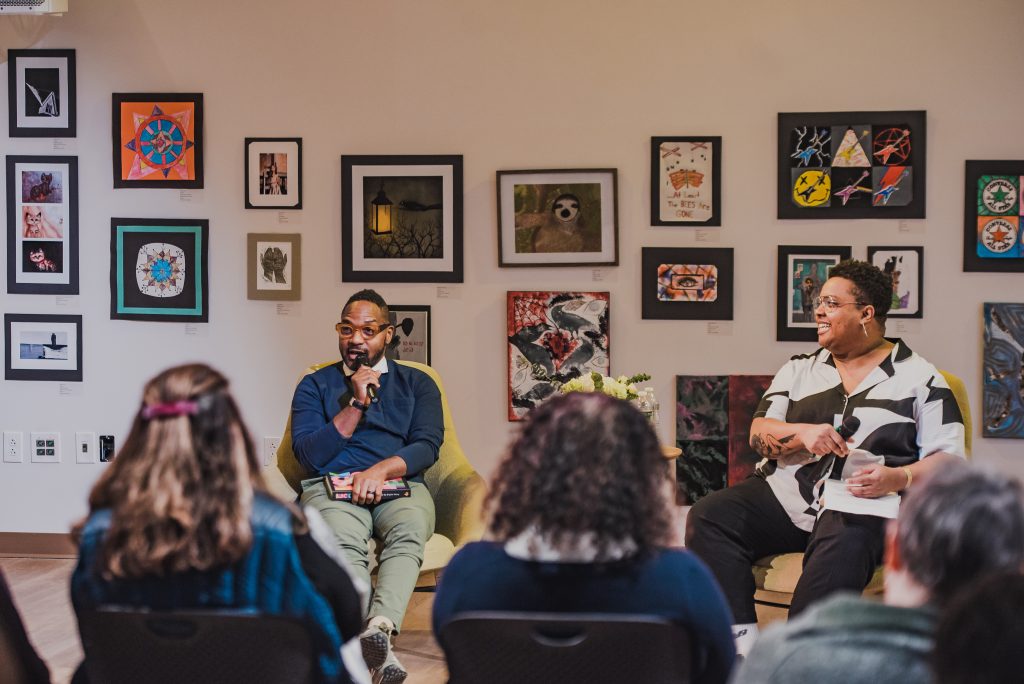
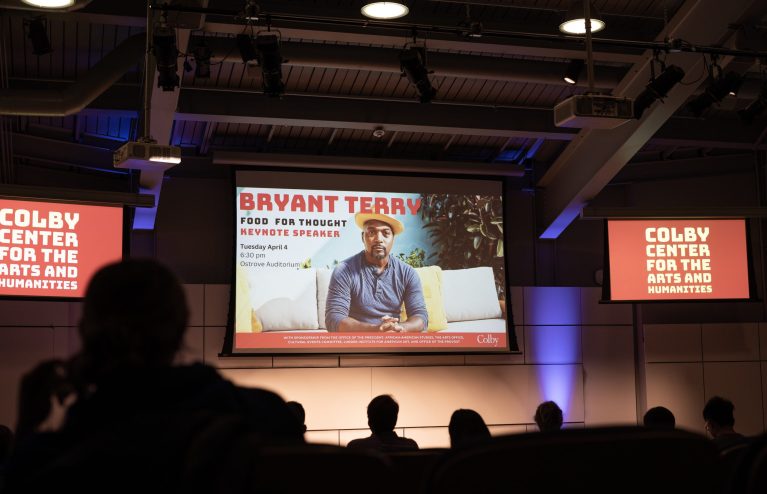
One of the most exciting events was the keynote speaker, Chef Bryant Terry, whose talk was a perfect ending to Food for Thought. During his three-day residency, Chef Terry held an engaging public conversation with Dr. Taryn D. Jordan (Colgate University) at the Greene Block + Studios while taking part in a popular student recipe contest in partnership with Colby Dining Services, an intimate dialogue with students at the Pugh Center, and a dynamic keynote lecture. The campus was abuzz with energy. Professor Cannamela shared her own experiences with Chef Terry, saying that “the keynote lecture was powerful and inspiring. I appreciated how Chef Terry has turned story-telling, visual arts, and music into an integral part of his recipes. I really saw how his creative thinking has connected the Humanities to an everyday practice—eating!—and to pressing discourses of social justice, equity, and inclusion.” Brunetaux noted that she is struck by how Chef Terry organizes his recipe books, which “are not just recipe books, but rather platforms to celebrate and embrace Black foods, cultures, culinary practices, his/her stories, and communities that have long been invisibilized.”
Reflecting on the bounty of programs, lectures, and food-filled events, it is clear that Food for Thought nourished a wealth of ideas across Colby College and the Waterville community, “The passion and compassion of such Colby students gives me hope for a more sustainable and equitable future,” said Singh. After a year of Food for Thought, it is clear that we can’t just rely on fast food solutions for these global food issues. We hope these events have inspired us all to slow down, savor the moment, and craft together a more sustainable recipe for the future.
Story by Portia Hardy, CAH Program Coordinator. Photography by Ben Wheeler.